





Yes. Significantly more often than you're probably doing it now.
Research from Ahrefs analyzing 17 million citations found that URLs cited by AI assistants are, on average, 25.7% fresher than those ranking in traditional organic results. ChatGPT has the sharpest preference: it cites URLs that are 393 to 458 days newer than what ranks well on Google.
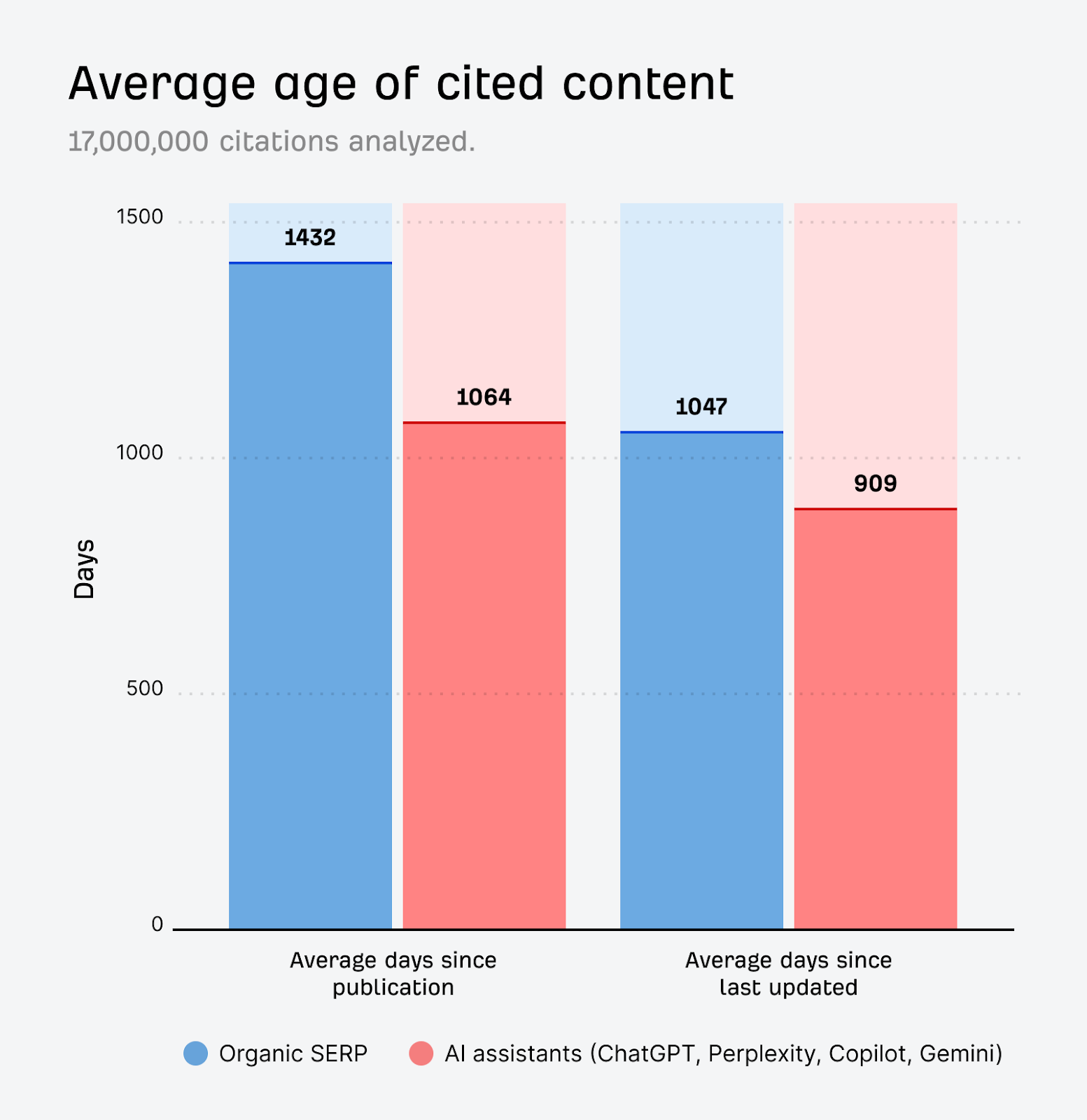
The stakes get worse for stale content. According to AirOps, content not updated in over a year is 50% less likely to be cited by ChatGPT. For commercial content, that shelf life shrinks to just 3 to 6 months.
Google's AI Overviews are a partial exception, still leaning toward slightly older, authority-heavy content. But across Perplexity, Gemini, and Copilot, the trend is consistent: recency wins.
How AI systems actually detect freshness
It's not just the "last updated" date. LLMs evaluate freshness through three layers:
1. Content freshness
Substantive changes to the actual text, facts, stats, and examples. Superficial edits, like bumping a publish date without changing the content, are detected and penalized. Google has a binary trust signal for lastmod abuse, and AI models drawing from Google's index inherit that skepticism.
2. Embedding freshness
When a page is re-crawled, it gets re-chunked and re-indexed into the vector database. This process has latency ranging from hours to weeks, so updates are never instant in AI retrieval systems.
3. Retrieval freshness
The retriever applies time-weighting and decay functions to favor recent pages, even if embeddings are slightly behind.
Other signals AI systems look for include:
- Crawlable modified dates
- New backlinks from recent sources
- Updated schema markup
- New sections (500+ words of net-new content) and
- Fresh external validation, such as press mentions.
The 90-day reality of AI citations
AI Overviews are highly volatile. Ahrefs research shows they have a 70% chance of changing between observations, with cited content persisting for only about 2.15 days on average. Between consecutive AI responses, 45.5% of cited URLs are entirely new.
This changes the content strategy calculus. Content that stayed relevant for 24 to 36 months on Google now has an effective AI shelf life of 6 to 9 months, and for competitive or commercial topics, closer to 90 days. Treating static content as a long-term asset in AI search is a losing strategy.
What to update and how often
Not all content decays at the same rate. Here's how to tier your refresh schedule:
Every 60 to 90 days
Commercial and YMYL content Product comparisons, "best of" lists, pricing pages, and reviews. New products launch, pricing shifts, competitors change. Anything a user would act on based on current accuracy needs to stay current.
Every 6 months
Evolving topic content SaaS guides, technology explainers, regulatory coverage, and industry trend pieces. These don't expire as fast but go stale quickly enough to lose citation priority without regular attention.
Annually
Foundational "stock" content Core concept pages like "What is SEO?" or "How does attribution work?" These don't require full rewrites, but adding fresh examples, updated statistics, or a 2025 context section refreshes the embedding without a full overhaul.
Seasonal content
Update 3 months before peak demand. If you have a "best CRM" or "tax tips" page, refresh it before the relevant season to capture early query volume before AI systems start cycling citations.
How to execute a substantive refresh
Sporadic updates don't work. You need a repeatable system: tier your content, then schedule refreshes as recurring sprints (for example, 10 pieces every 90 days).
A substantive update means making real changes. Here's what counts:
- Rewrite the intro to reference recent developments
- Replace stats with data from the last 12 months
- Add new sections addressing emerging subtopics or FAQs
- Update screenshots to reflect current UI
- Refresh terminology (adding terms like "LLM," "GEO," or "AI Overviews" to older SEO guides)
- Add internal links from newer content to the refreshed page
After publishing, use IndexNow to ping Bing (which powers ChatGPT) immediately. Then treat the refresh like a new publish: share it on social and in your newsletter to generate fresh engagement signals.
The caching problem (and why topical authority still matters)
Even after a meaningful update, AI systems may cite the old version for days or weeks. Cached answers persist until they expire or the system detects a substantive change on the next crawl cycle.
This is why page-by-page freshness alone is not enough. AI citations are volatile by design. The more durable strategy is building topical authority across a content cluster. When AI systems consistently associate your brand with a core theme, you'll receive more reliable citation patterns than you would by chasing freshness on individual pages.
Freshness gets you into the rotation. Authority keeps you there.