





Not yet, but it's increasingly likely within the next 12-18 months.
Microsoft is currently testing an AI Performance report inside Bing Webmaster Tools, giving site owners visibility into how their content performs within AI-driven search features. Click-through data is notably absent, but it still represents more transparency than anything Google currently offers.
When one platform gives webmasters a way to measure AI visibility and the other doesn't, it becomes a real differentiator for where SEOs focus their optimization efforts.
Where Google stands right now
Google currently bundles all AI search features (AI Overviews, AI Mode) together with traditional web search inside Search Console. There's no way to isolate AI-specific performance data. If your traffic dropped after an AI Overviews rollout, GSC won't tell you why or where.
This is a significant blind spot, and the SEO community has noticed.
What Google has quietly been building
Google hasn't been standing still inside Search Console. Recent updates include query groups, social channels tracking, and AI-powered configurations that surface performance insights faster. The difference is in the approach: rather than creating new AI-specific reports, Google has been using AI to improve how existing data is filtered and analyzed.
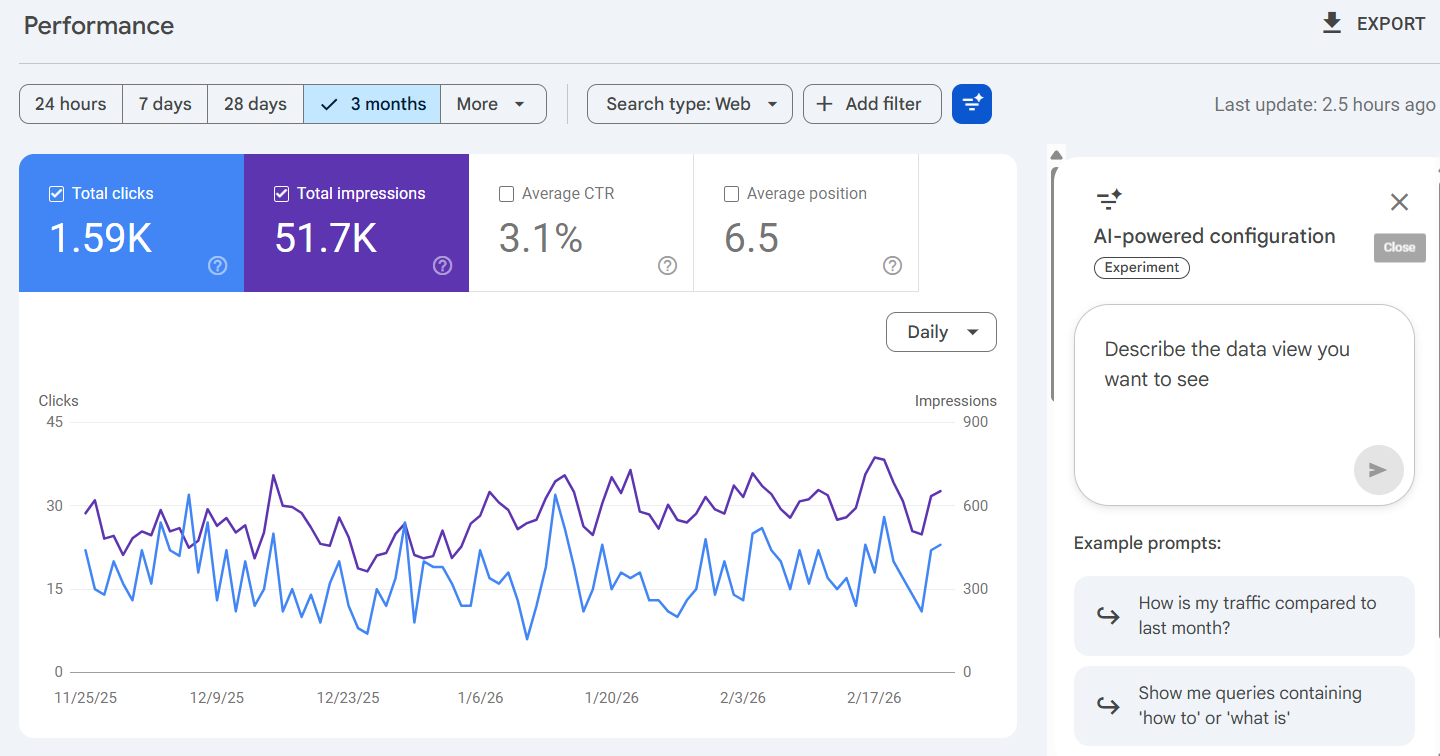
Search Console now supports conversational filtering, letting you type natural language queries like "show me product pages with declining CTR" instead of manually configuring filters. It's a meaningful UX upgrade, but it's still not the same as a dedicated report showing how your content performs inside AI-generated responses.
The pressure building on Google
Three forces are pushing Google toward greater transparency here.
Publisher losses are severe
Smaller and mid-sized publishers have reported traffic drops of up to 70% following AI Overviews rollout. Publishers are struggling to justify content investment without any data on AI visibility.
The SEO industry is asking directly
The question has been put to Google's John Mueller repeatedly. The demand from SEO professionals for AI performance data broken out from traditional web search is not subtle.
Bing's move creates competitive pressure
If Microsoft provides transparency that Google withholds, webmasters and publishers have a reason to prioritize Bing optimization. That's not a dynamic Google typically tolerates for long.
What John Mueller actually said
When asked directly whether AI Overview or AI Mode insights would be coming to Search Console, Mueller said:
"While I have nothing to announce, I can say for sure that very few things online are permanent."
That's as close to a non-denial as you'll get from Google. The follow-up framing that "things change" and that few decisions are permanent keeps the door open without committing to anything.
Industry experts like Lily Ray responded with skepticism, reflecting a widely held view that Google won't offer this data easily or quickly. That skepticism is reasonable given Google's history, but Mueller's phrasing is still worth noting.
What a Google AI report would likely include (and skip)
Based on Bing's approach and Google's historical behavior around click data, here's a realistic picture of what any future report might look like.
What would probably be included:
- Citation frequency in AI-generated responses
- Brand mention visibility within AI answers
- Visibility indicators similar to what third-party tools like AthenaHQ and Conductor already track
What would almost certainly be excluded:
- Click-through rates from AI Overviews or AI Mode
Google has a structural disincentive to show click data for features that keep users on the search results page. With 60% of searches now ending without a click, surfacing that data prominently would directly highlight how much traffic sites are losing to Google's own features. Don't expect that to appear in a first release.
Why Google might eventually release it anyway
There are real reasons beyond competitive pressure.
Google's Responsible AI Progress Report emphasizes transparency as a core principle. Giving site owners data about their AI visibility fits that messaging and can be framed as part of responsible AI deployment.
There's also a practical ecosystem argument. If publishers can't measure their AI visibility, they'll struggle to justify ongoing content investment.
That degrades the quality of the web content that Google's AI relies on for grounding its responses. Google has an incentive to keep the content ecosystem healthy, and transparency tools help do that.
What's the realistic timeline?
An AI visibility report inside Search Console is plausible within 12-18 months, based on Mueller's non-denial and the direction of GSC development. The more likely path is integration rather than a standalone product: AI insights folded into existing reports, similar to how query groups and AI-powered configurations were quietly added.
Watch for changes to Search Console's API and reporting structure. The addition of social channels tracking shows Google is willing to expand what GSC measures. AI visibility is the obvious next candidate.
The question isn't really if. It's how much Google will actually show when it gets there.