





Bing's AI Performance report is the first first-party tool that lets SEOs track citation success inside AI-generated answers, specifically Bing Copilot. Unlike third-party tools that estimate AI visibility through scraping, this data comes directly from Bing.
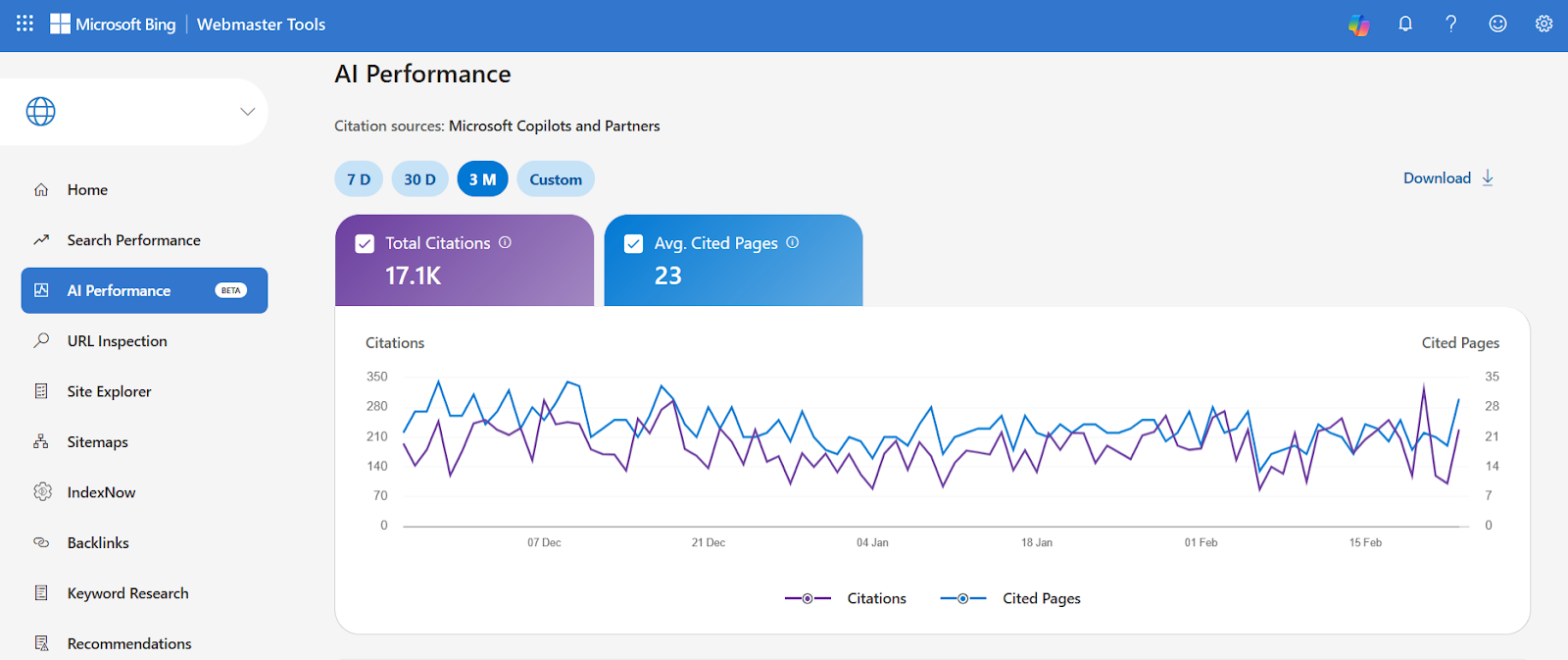
Google has no equivalent yet, making it the most reliable foundation available for building and validating an AI SEO strategy, with learnings that transfer to Google AI Overviews and other LLMs.
It runs alongside the standard Bing Search Performance report, not instead of it. Standard SEO is still relevant. What changes is what you now measure and optimize for on top of it.
From ranking pages to tracking citations
Blue-link rankings still matter, but the AI Performance report adds a parallel success metric: citations inside Copilot responses. AI answers satisfy queries directly, so many searches end without a click. Appearing inside the answer still builds brand authority and trust, and this dashboard is the first tool to measure that with first-party accuracy, giving SEOs something concrete to report to stakeholders rather than an estimate.
Grounding queries are your new keyword data
Grounding queries are not user prompts. They are the specific phrases Bing's AI uses internally to retrieve your content when generating an answer.
Analyzing them reveals the semantic gap between your intended keyword targeting and how the AI actually categorizes your content. If high-value pages are being retrieved for unexpected phrases, the content needs recalibration. This is keyword research from the machine's perspective, and because it comes directly from Bing's retrieval system, it is more actionable than most keyword tools.
These insights also translate beyond Bing. The same semantic patterns that drive retrieval inside Copilot likely influence how Google AI Overviews and other LLMs surface your content.
Average cited pages: build breadth, not just depth
Average Cited Pages tracks how many unique URLs from your domain are cited in AI answers on a given day.
High total citations concentrated on a handful of pages is a risk. If those pages go stale or lose relevance, your AI visibility drops sharply. The fix is breadth: identify your most-cited pages, reverse-engineer what makes them citation-worthy (structure, depth, directness), and replicate those patterns across your broader content library.
Write for extraction, not just reading
Bing's AI breaks pages into blocks to pull out complete ideas. Every section of a priority page needs to be self-contained.
The practical rules: H2 and H3 headings should each cover one distinct idea, paragraphs should sit between 40 and 80 words, and every key page should open with a direct answer to its core query. That lead paragraph is the AI's most obvious extraction point and the reader's first reason to continue.
FAQ, HowTo, and Article schema are no longer optional. They give Bing explicit Q&A pairs to pull into Copilot answers, and the same structured data improves your odds in Google AI Overviews.
Technical SEO: freshness and the push model
LLMs work from indexed snapshots. Without proactive signaling, your newest content may not surface in AI answers at all.
Use IndexNow and updated XML sitemaps to push content to Bing the moment it is published or updated. For time-sensitive topics, the gap between publication and indexation directly affects citation eligibility.
Back this up with regular content audits: monthly for evergreen guides, quarterly for high-traffic posts. Outdated content reduces retrieval quality across both standard search and AI citations.
New KPIs for an AI-first reporting layer
The AI Performance report adds metrics on top of standard reporting, not a replacement for it. Rankings, impressions, and clicks from the Search Performance report still belong in your dashboard. What changes is what sits alongside them.
Key AI metrics to track:
- Total Citations (overall Copilot visibility)
- Citation Share by Engine (distribution across Copilot and partner platforms)
- Prompt-Win Rate (how often your content wins the citation when a relevant prompt fires).
- Grounding query samples also surface topical gaps worth addressing in your content calendar.
Traffic volume may dip as AI answers absorb more queries, but visitors who do click tend to be further down the funnel and more likely to convert. Reporting should reflect that quality shift, not just the volume drop.
Control what the AI extracts
The data-nosnippet HTML attribute lets you exclude specific page sections from Bing snippets and Copilot answers without removing the page from the index.
Use it on paywalled content, legal disclaimers, outdated pricing, and volatile review scores. This gives you direct control over what appears inside AI-generated responses, turning brand reputation management into a technical SEO task rather than something left to chance.