





The metrics that matter most in the AI search era are the ones that capture influence, not just clicks.
AI Overviews and direct answers have broken a core assumption: that discovery leads to a click. When an AI answers a query on the results page, CTR can drop from around 3% to under 1%, yet brand influence still happens. Roughly 60% of searches now end without a click, meaning users are shaped invisibly.
Metric 1: AI mention rate
- What it is: The percentage of a defined set of high-value prompts (for example, "best CRM for small business") where an AI assistant explicitly references your brand.
- Why it matters: This is your visibility score in the AI layer. A strong mention rate signals that AI systems associate your brand with authority on topics that drive your business.
Track branded prompts (reputation, narrative consistency) separately from unbranded, category-level prompts (opportunity, discovery). Audit a fixed list of 10 to 20 priority prompts monthly across ChatGPT, Gemini, and Perplexity.
Your core KPI: unique prompts with at least one brand mention. LLM tracking tools like Otterly.AI and LLMClicks can automate this.
Metric 2: Grounding query presence
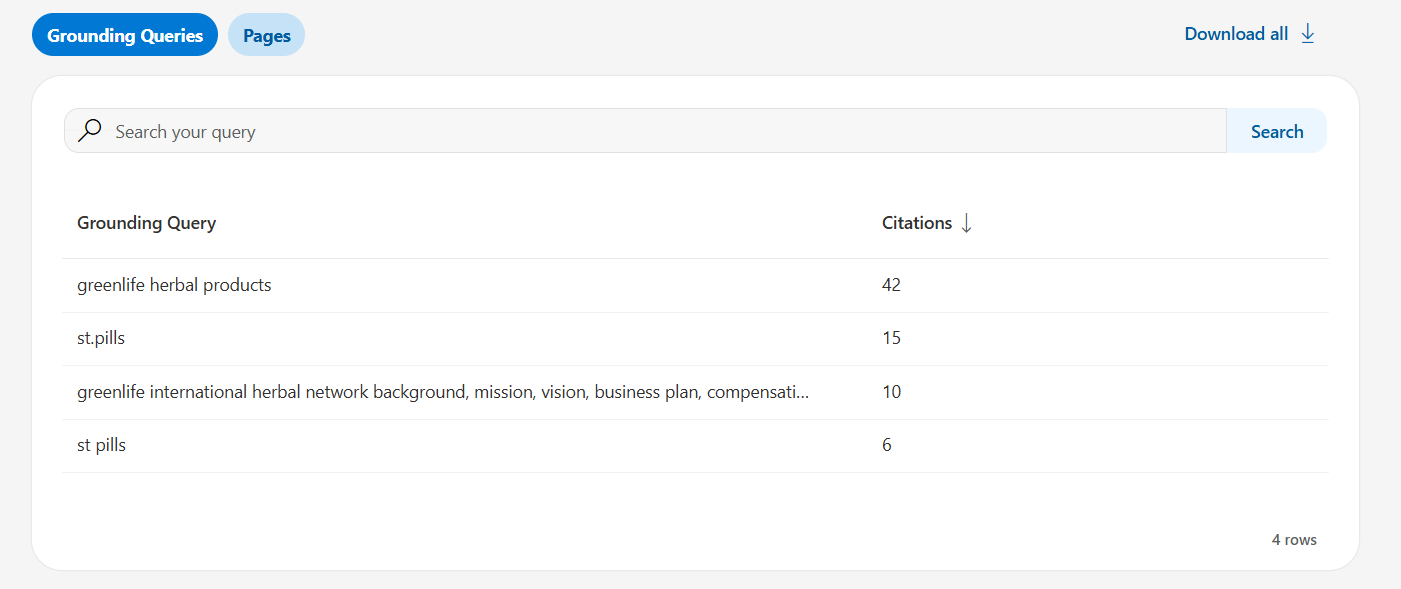
- What it is: The specific keyword phrases AI systems use internally to retrieve content when generating answers. These are not the user's original question; they are the searches the AI runs in the background.
- Why it matters: Grounding queries reveal how AI systems categorize your content. If your page is retrieved for "OAuth implementation enterprise," that is how the AI sees you regardless of the keywords you targeted.
Bing's AI Performance dashboard (launched February 2026) now provides first-party data on grounding queries, citation frequency, and page-level citation activity. It is the first major search engine to offer dedicated AI visibility metrics. Use this data to identify the "AI perspective" on your content, then adjust topical coverage to match the queries that are actually driving citations.
Metric 3: AI referral traffic
- What it is: Sessions and conversions coming directly from AI platforms such as ChatGPT, Perplexity, Gemini, and Microsoft Copilot.
- Why it matters: AI referral volumes are still small (averaging around 2.8% of traffic in IT industries), but the quality is disproportionately high. AI search visitors are approximately 16% more likely to convert compared to other traffic sources.
Set up a custom "AI Traffic" channel grouping in GA4 using sources like chatgpt.com, perplexity.ai, and gemini.google.com. Track sessions, engagement rate, and conversions monthly.
Metric 4: Branded search volume trend
- What it is: Impressions and clicks for queries containing your brand name, tracked through Google Search Console.
- Why it matters: Branded demand is the clearest signal of market relevance in an AI-first world. Many AI-influenced journeys end in a later branded search, which means this metric captures influence that AI referral tracking alone will miss. If branded search remains stable or grows while non-branded traffic fluctuates, your brand is breaking through even in zero-click environments.
Set up a regex filter in Google Search Console to capture all brand name variations. Review impressions and clicks month-over-month and year-over-year.
Metric 5: MQLs from organic and AI traffic
- What it is: Marketing qualified leads generated from organic search and AI referral traffic combined.
- Why it matters: Sessions do not indicate success on their own. If traffic declines but MQL volume holds steady or increases, your visibility has improved in quality, which is a common pattern as AI-driven discovery grows.
In GA4, create a report combining your Organic Search and AI Traffic channels. Monitor total MQL count and combined conversion rate monthly.
Metric 6: Narrative consistency score
- What it is: A measure of how accurately and consistently AI platforms describe your brand, products, or positioning compared to your official messaging.
- Why it matters: Different AI models describe the same brand differently. If Gemini emphasizes one product feature while ChatGPT highlights another, your narrative is not pulling through. As AI raises the stakes around trust and authority, inconsistent AI descriptions create a real reputation risk.
Manually audit how your priority prompts are answered across platforms. Compare the AI's description against your brand guidelines and score for accuracy and consistency. Do this quarterly at minimum.
A practical measurement framework
Split your metrics into two buckets:
- Performance metrics (what is happening): AI mention rate, grounding query citations, AI referral traffic volume, branded search impressions.
- Impact metrics (what it drives): MQLs from organic and AI traffic, conversion rate from AI sessions, branded search click trend.
One important expectation to set: AI presence fluctuates month-to-month due to model updates. Treat short-term changes as directional signals, not absolute truth. Trends over rolling 90-day windows will give you the clearest picture.