





No, grounding queries are not the new search queries. They are the backend search queries.
The user's query hasn't changed. What's changed is that an AI now runs its own keyword-style searches in the background to find sources before it answers you.
How AI runs its own searches behind the scenes
When a user asks an AI a question, the system decides whether it needs fresh data to answer accurately. If it does, it generates a grounding query; a traditional, structured search string, sends it to a search engine like Google or Bing, reads the top results, and uses that content to formulate its answer.
Users never see this happen; however, developers do, since these queries surface in API metadata such as webSearchQueries.
For complex questions, the model doesn't run just one search. It runs several, a process known as "fan-out." Each grounding query targets a different angle of the topic, pulling in multiple sources to cover the full answer.
The AI is essentially doing what a thorough researcher does when they search the same topic multiple ways before writing anything.
What's actually inside a grounding query
Technically, a grounding query is a string, something as direct as "What's a monstera?" generated by the model to fetch specific chunks of content from the web.
Grounding queries translate vague, conversational user prompts into the kind of exact, structured language that a traditional web index can match against.
The user says, "Hey, what are some good indoor plants for low light?" The AI turns that into two or three targeted searches and retrieves the relevant facts. You never typed those searches. The AI did it for you.
Ranking still matters, but the unit has changed
Here's where it gets important for SEO.
Recent research analyzing over 7,000 queries found that Google's AI operates with a finite "grounding budget": roughly 2,000 words of total source content per response. It doesn't read your whole page. It pulls specific chunks: sentences and paragraphs that directly answer the grounding query it ran.
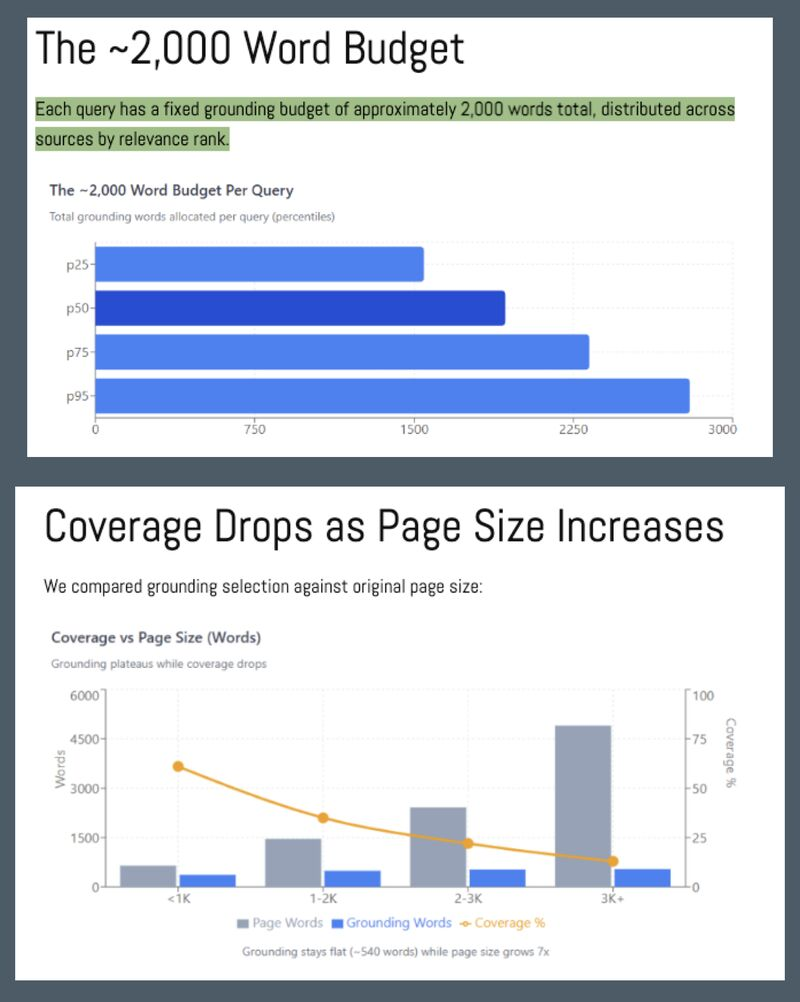
The correlation between traditional search ranking and being selected as a grounding source is significant. Pages that rank higher for a given grounding query tend to receive a larger share of that grounding budget.
So the mechanics of traditional SEO: domain authority, on-page relevance, structured content, generally still determine who gets used as a source.
But the unit of value has shifted. It's no longer the page. It's the chunk, a specific sentence or paragraph that directly answers what the AI was looking for. The AI can pull a relevant sentence from paragraph seven of your article without reading paragraphs one through six.
If your most information-dense content is buried under filler, it still has a chance to surface. If your page has no information-dense content at all, it doesn't.
Where grounding queries replace search, and where they don't
For the user, the experience has fundamentally changed. For fact-based queries: definitions, specifications, comparisons, how-to answers, most users no longer type a search, scan blue links, and click through. The AI synthesizes the answer directly. The grounding system handles the searching. This is a real behavioral shift that isn't reversing.
For the system, nothing has replaced the underlying infrastructure. Google's index, its crawling mechanisms, its document-matching logic, all of it is still the prize. The AI is entirely dependent on the search engine's ability to return relevant results for the grounding queries it generates. No index, no grounding. The web still needs to be crawlable, indexable, and rankable for any of this to work.
The human behavior underneath it all, the drive to find information, hasn't changed. The experience layer has. SEO's job is now to be the source inside the answer, not just the link below it.
What this means for your content strategy
Optimize for the grounding query, not just the user query
Since the AI generates specific search strings to find its sources, your content needs to directly and precisely answer those strings. High information density wins. A crisp, accurate two-sentence answer to a specific question will outperform a 2,000-word article that takes 800 words to get to the point.
Build grounding pages
Think of these as mini-wikis: tightly structured pages that cover a topic with clarity, defined terms, clear specifications, and structured data markup. If the AI runs a grounding query about product specs or technical definitions, your page needs those facts stated plainly and tagged properly to be selected as a source.
Track citation volume, not just rankings
Visibility in AI responses requires a different measurement framework. The KPIs that matter now include how often your content is cited in AI-generated answers, what sentiment surrounds those citations, and which content clusters are being used as grounding sources versus which ones are invisible to the model.