





Yes, but not as a standalone metric and not as a replacement for what you're already tracking.
AI has created a parallel discovery layer where users form preferences and build consideration sets before a single click happens. If your measurement strategy ignores that layer, you're missing a growing portion of your actual influence on buyers.
Why traditional metrics no longer tell the full story
Impressions, clicks, and organic traffic still matter. But they were built to measure a world where discovery happened on a search results page. That world is changing.
AI systems now answer questions directly. When a user asks ChatGPT for the best project management tool for remote teams, they get a curated response. If your brand isn't in that response, you didn't lose a click. You were never part of the consideration set to begin with.
This is the "good enough answer" effect. When AI gives users what they need immediately, there's no reason to visit a website, even if your content powered the answer. That content is working, just upstream, in a place your current analytics cannot see.
What the data actually shows
The Conductor 2026 Benchmarks Report, which analyzed 3.3 billion sessions across 13,000+ domains, found that AI accounts for roughly 1% of all website traffic on average, growing at about 1% month-over-month.
That number will mislead you if you focus on it too narrowly. The real impact is not in the click; it's in the exposure.
Google AI Overviews now appear in approximately 25% of all searches, climbing to nearly 50% in sectors like healthcare. These responses shape which brands users consider long before they type a branded query. And nearly 90% of all AI referral traffic currently originates from ChatGPT, making it the primary platform to monitor for most teams.
The core KPIs that define AI visibility
Share of model (AI shelf share)
How often and how prominently does your brand appear in AI-generated answers compared to competitors? This is not about ranking for a keyword. It's about occupying space in the response itself.
Citation frequency
How often do AI systems reference your website, product pages, or specific content assets as sources? Citations have become the new trust signal. A brand that gets cited consistently builds authority in the model's "understanding" of its category.
Sentiment and narrative consistency
When AI describes your brand, is that description accurate? Is it framed positively, neutrally, or negatively? Tracking whether your core brand narrative is pulling through across different AI engines (ChatGPT, Perplexity, Gemini) matters more than most teams currently realize.
Unbranded vs. branded prompt presence
Are you appearing for category-level questions like "best CRM for small business," or only when someone searches your name directly? Unbranded presence signals opportunity. Branded presence signals reputation management. You need both, and they require different strategies.
How to actually measure this
The tool market has matured quickly. You have options at every budget level.
For dedicated AI visibility tracking, platforms like OtterlyAI, Ziptie.dev, and Rankshift.ai offer dashboards that monitor brand mentions, citations, and sentiment across multiple AI engines. These are built specifically for this use case.
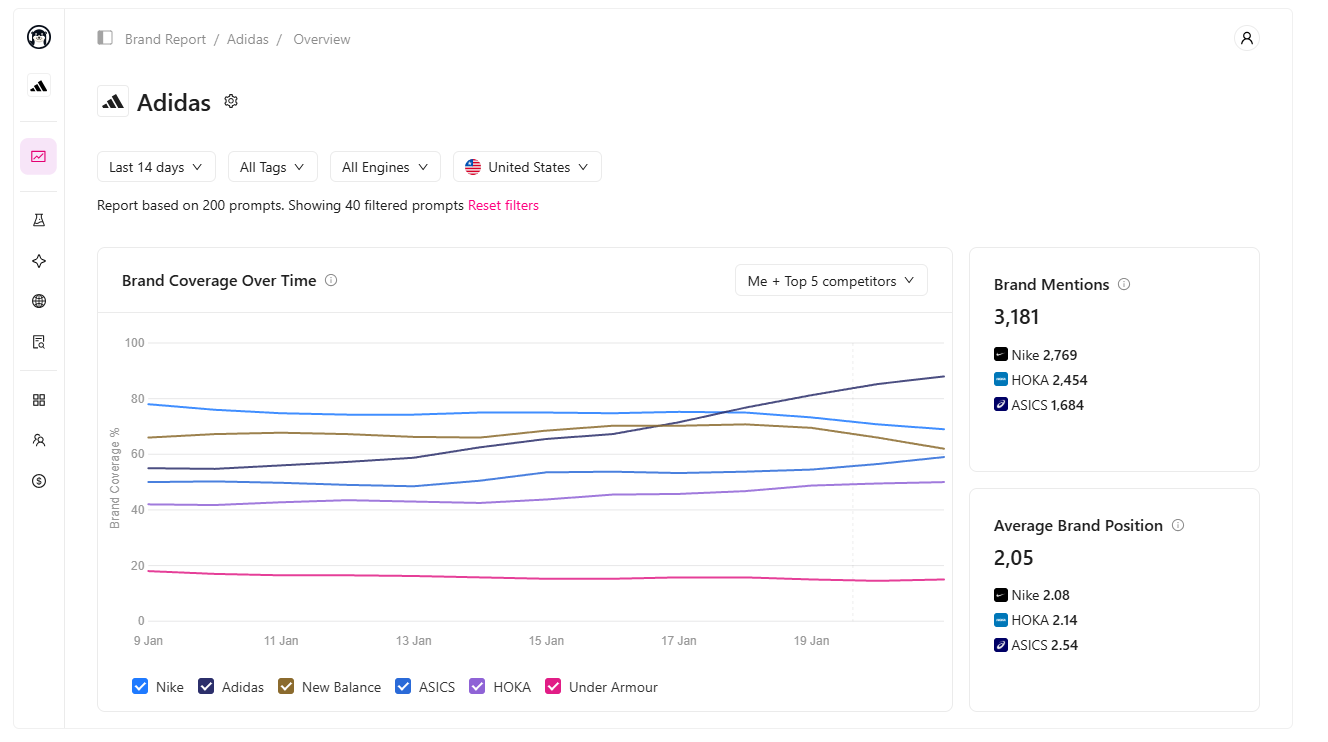
At the enterprise level, Conductor and Meltwater have integrated AI visibility metrics (often labeled as AEO or GEO metrics) into broader reporting frameworks, connecting AI presence to downstream business outcomes.
If you're starting lean, Ubersuggest and RankScale offer basic tracking. Google Analytics via Looker Studio templates can also be configured to monitor referral traffic from AI platforms like Gemini and Perplexity, giving you directional data without additional spend.
Start by establishing a baseline. Most teams are still in a benchmarking phase with no historical data to compare against. That is expected and normal. The goal right now is to start measuring so you have something to optimize against later.
How AI visibility connects to revenue
Users who encounter your brand in an AI answer often return later through branded search, direct traffic, or other measurable channels. This means growth in branded search volume and higher-quality direct traffic can serve as downstream validators of AI visibility performance, even when attribution is indirect.
The conversion data also supports prioritization. AI-influenced sessions convert at higher rates than standard organic traffic because users arrive with clearer intent and more informed expectations. They've already done their comparison shopping inside the AI tool. By the time they visit your site, they're closer to a decision.
The underlying logic is a shift from marketing to becoming a source of truth. Brands that appear consistently in AI answers earn credibility that compounds over time. When the user is ready to buy, those brands are already on the shortlist.