





AI queries are conversational, full-sentence requests that express intent and context. Traditional search queries are short, fragmented keyword strings that users construct to match how they think a search engine works.
The difference is not just stylistic; it changes what gets asked, how it's phrased, and how specific users are willing to be.
Query length and structure
Traditional search queries are short by design. Users have been conditioned over decades to compress their needs into two to four keywords: "best CRM small business" or "running shoes flat feet." Anything longer felt like it wouldn't work, because early search engines couldn't handle it.
AI queries break that habit entirely. Users ask in full sentences or even paragraphs.
"I run a 12-person SaaS company, and we're outgrowing spreadsheets,what CRM would work for us without a huge onboarding lift?"
This is a perfectly valid AI query. Users no longer need to translate their actual question into machine-friendly fragments.
How much context users include
In traditional search, context gets stripped out. You don't tell Google you're a first-time buyer, that you live in Lagos, or that you've already tried three other solutions. The query box doesn't invite that, and including it rarely improved results.
AI queries invite context. Users routinely include their situation, constraints, prior attempts, and goals because the system actually uses that information to shape the answer.
The query becomes a brief:
"I'm training for my first marathon, I have flat feet, and I've had knee issues in the past, what shoes should I consider?" That level of detail would be useless in a Google search bar. In an AI query, it's valuable input.
Specificity and nuance
Traditional queries tend toward the generic because specificity often hurt more than it helped. Too many modifiers and you'd get zero results, or results that matched your exact phrasing rather than your actual intent.
AI queries trend toward the specific. Users ask nuanced, layered questions, ones with multiple conditions or sub-questions embedded in a single prompt.
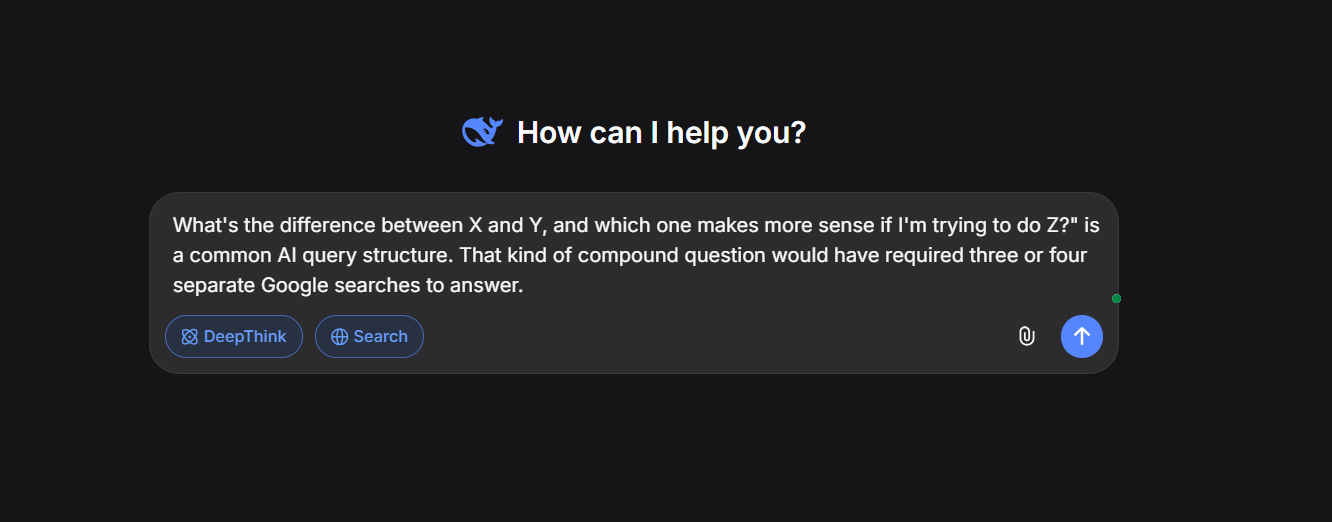
"What's the difference between X and Y, and which one makes more sense if I'm trying to do Z?" is a common AI query structure. That kind of compound question would have required three or four separate Google searches to answer.
Multi-turn vs. Single-shot
A traditional search query is a standalone transaction. You type, you get results, you either click or rephrase and search again. Each query is independent. There's no memory between them.
AI queries can be iterative and conversational. Users build on previous questions: "Can you expand on the second option?" or "What would that look like for a smaller budget?" without restating the entire context. The query isn't just a single input; it's part of a dialogue. This changes how users approach information-seeking entirely. Instead of planning a search session, they have a conversation.
How users express intent
In traditional search, intent is implied through keyword choice and modifiers. A user searching "buy running shoes online" signals purchase intent through the word "buy." A user searching "running shoes flat feet review" signals research intent. Marketers and SEOs learned to decode these signals and optimize for them.
In AI queries, intent is stated directly. Users explain what they're trying to accomplish, not just what they're looking for. "Help me decide between X and Y" or "Give me a plan for doing Z" are explicit statements of intent that traditional search queries rarely contained. The query itself carries the goal, not just the topic.
Tolerance for ambiguity
Traditional search queries are often deliberately vague, not because the user's need is vague, but because the user doesn't trust that a specific query will return useful results. Broad queries felt safer.
AI queries reward precision. The more clearly a user defines what they want, the better the output. This shifts the burden of disambiguation: in traditional search, the engine had to guess what you meant from a vague phrase; in AI search, users are increasingly willing to spell it out because specificity pays off.
What this means for SEOs
Users querying AI tools aren't thinking in keywords. They're thinking in problems, situations, and goals and asking accordingly. For content to surface in AI-generated answers, it needs to be written to match that kind of language: specific, contextual, passage-level answers to real questions people actually ask, not keyword-optimized pages built for fragmented two-word queries.