





Grounding queries are not the prompts users type into ChatGPT or Perplexity. They are the specific, traditional-style web searches (Google/Bing queries) that an LLM executes in the background to fetch fresh, factual data before generating its answer.
This distinction is critical for keyword research, as you are no longer just targeting what a user types into an AI chatbot. You are targeting the specific search results the AI reads to construct that answer. If your content appears in those background searches, your brand gets cited.
Identifying which queries actually trigger grounding
Not every query causes an LLM to search the web. The model only grounds when it lacks confidence in its training data.
Static definitional facts ("What is SaaS?") rarely trigger grounding. The LLM already knows the answer. Focus your research on queries involving:
- Recent statistics or benchmarks
- Product comparisons and pricing
- Named tools, companies, or people
- Current events or annual rankings (e.g., "best project management tools 2025")
These are the categories where the model is uncertain and will always search before answering.
Here are three ways to discover grounding probability:
ChatGPT network analysis
Open your browser's developer console while using ChatGPT. Go to the Network tab and filter for search-related requests. Look for the search_prob value returned in the response payload. A value above 0.5 indicates the model is likely to trigger a grounding search for that query. This method is technical but gives you direct, first-party data.
Google Gemini API
The Gemini API includes a grounding confirmation feature. When you run a query through it, the API not only confirms whether grounding occurred but returns the exact web searches the model executed. This is one of the most precise ways to reverse-engineer AI search behavior and build a keyword list directly from model behavior.
Public ML prediction tools
Researcher Dan Petrovic and others in the AI SEO community have published open-source models that bulk-predict grounding probability across large keyword lists without requiring code or API access. Run your existing keyword lists through these tools to quickly separate static knowledge queries from high-grounding opportunities.
Mining the actual search terms AI ses
Once you know grounding is happening, the next step is extracting the exact search strings the AI runs.
Bing webmaster tools – AI performance report.
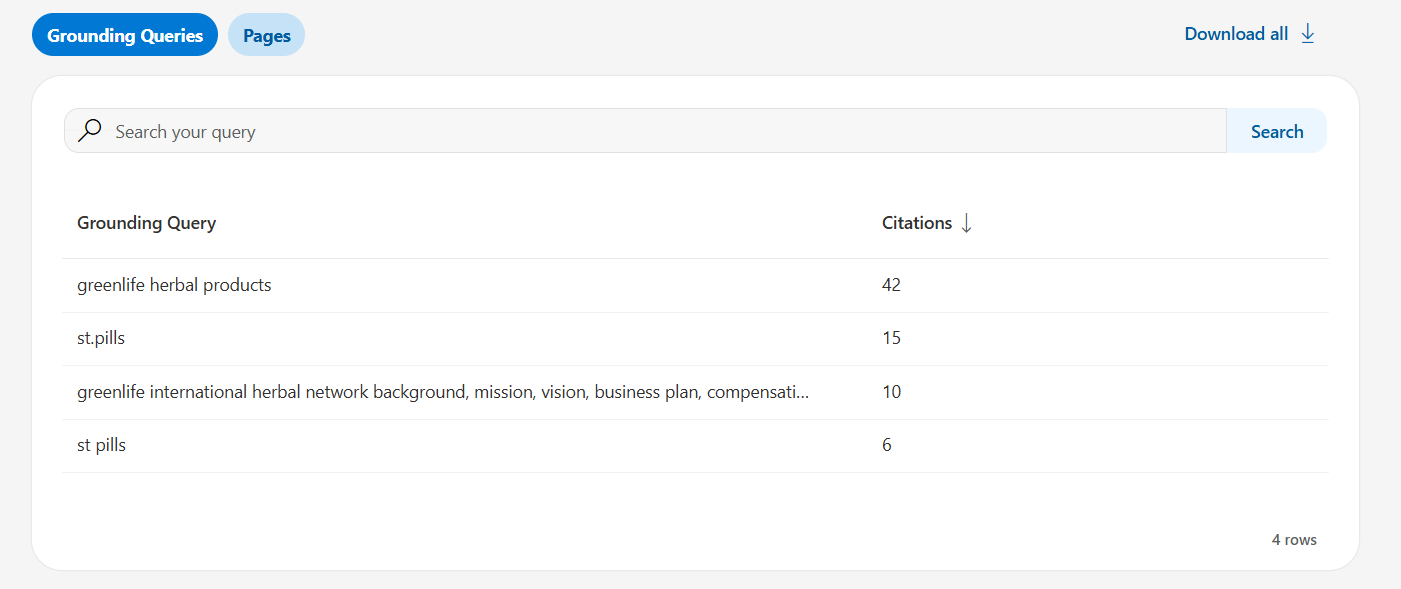
Microsoft now provides an "AI Performance" report inside Bing Webmaster Tools. This report explicitly lists the grounding queries that led to your site being cited inside Microsoft Copilot. If you are already being cited for some queries, this gives you a confirmed list of high-value terms to double down on. If you are absent, it shows you exactly what to target.
AI visibility platforms
Tools like Spyglasses deconstruct AI discovery sessions to surface the exact fan-out searches that AI assistants run (e.g., "best project management tools 2026," "affordable CRM for startups"). These platforms essentially translate vague AI prompt data into concrete, rankable keyword lists. Use them to build a working list of grounding search terms your content should be targeting.
Reverse-engineering competitor citations.
Monitor which queries your competitors are being cited for inside Copilot, Perplexity, and ChatGPT. If a competitor consistently appears when the AI searches "top email marketing platforms," that is a confirmed high-value grounding query where your absence is a gap you need to close.
Prioritizing opportunities with an Impact Score
Not all grounding searches are equal. Prioritize using three criteria:
Frequency
A grounding search triggered by thousands of user prompts per month is worth more than ranking for five low-volume variations combined. Weigh frequency heavily when building your target list.
Ranking gap
Cross-reference your grounding query list against your current Google and Bing rankings. If the AI searches for "best running shoes 2026" and you already rank in positions 1–5, your citation probability is high. If you rank outside the top 20, you are invisible to the model. Target grounding searches where you are close to the top but not there yet; these are your fastest wins.
Competitive density
Identify grounding searches where competitors rank well but you do not appear at all. These represent immediate AI visibility gaps. Closing them is both a traditional SEO win and an AI citation win simultaneously.
Mapping grounding searches back to content strategy
The final step is translating your grounding query list into a content system that captures multiple searches efficiently.
Content consolidation
A single, comprehensive guide should target multiple related grounding searches. One well-structured "best CRM" guide can capture grounding searches for "top-rated CRM tools," "CRM pricing comparison," "CRM for small business," and "CRM with free trial," all within the same page. Structure your content with clear H2s and data tables so AI models can extract specific answers from each section.
Optimize for both Google and Bing
Different AI platforms use different underlying search engines. ChatGPT and Copilot lean on Bing. Gemini and AI Overviews use Google. Perplexity uses both. A content strategy that only optimizes for Google is leaving half the AI citation landscape unaddressed. Check rankings on both engines for every grounding query on your list.
Measure the right thing
Stop measuring AI visibility by tracking whether your brand name appears in a chatbot response to a vague prompt. Instead, measure whether your content ranks in positions 1–20 for the specific grounding searches you have identified. The AI typically summarizes the top 10–20 web results it retrieves. Being present in that pool is the metric that actually determines citation frequency.
Build your content calendar around grounding searches, not around user prompts, and your SEO strategy will compound across both traditional search and every AI platform that relies on it.