





Yes. Pages with structured data markup are cited by AI systems at significantly higher rates than those without it.
Approximately 65% of pages cited by Google's AI Mode and 71% of pages cited by ChatGPT include structured data. That's not a coincidence.
But the mechanism matters. Structured data is not a direct ranking factor for LLMs.
Adding or removing schema often produces zero change in citation frequency on its own. It doesn't "boost" your page the way a backlink might. Instead, it acts as a representation layer: it reduces the inference cost for AI systems trying to determine whether they can trust and cite your content by explicitly labeling entities and their relationships.
Think of it as making your content easier to verify, not easier to find.
How structured data helps AI understand (and cite) you
Entity recognition and disambiguation
Schema helps AI systems identify your brand as a distinct entity with specific attributes: locations, services, credentials, products. This is especially critical for complex businesses where ambiguity is high. Without it, an AI has to infer who you are and what you do from unstructured text alone, and inference introduces error.
Feeding the knowledge graph
Structured data populates the knowledge graphs that generative AI models rely on for factual grounding. Bing Chat, for example, uses Schema.org data specifically to enhance its knowledge panels. When your data is machine-readable and well-labeled, it becomes a reliable input for these systems.
Reducing hallucinations
By providing grounded, machine-readable facts, structured data gives AI retrieval systems, including those used in Retrieval-Augmented Generation (RAG), reliable sources to draw from. This reduces the risk of an AI generating incorrect information about your brand because it has less need to fill gaps with inference.
Which schema types matter most
Structural schemas dominate
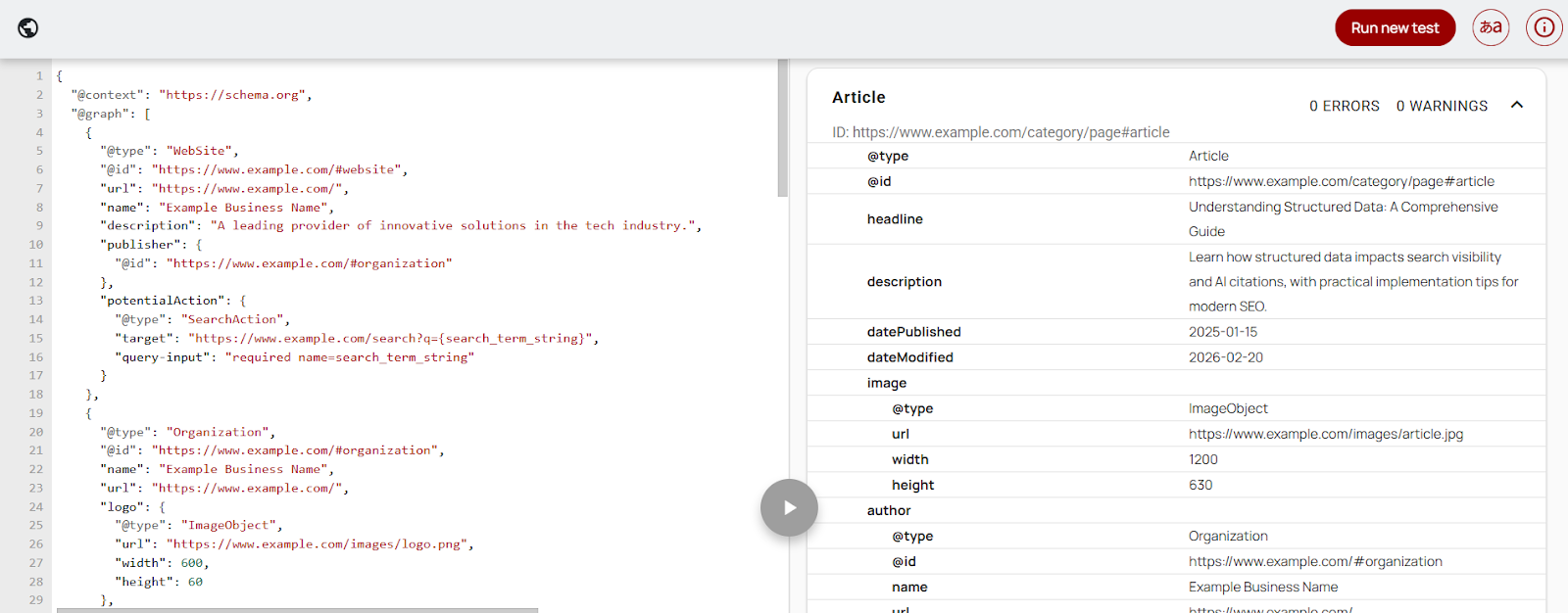
The most common schema types on AI-cited pages are foundational:
- BreadcrumbList: 38-42% of cited pages
- WebSite: 34-36%
- Organization: 31-32%
- WebPage: 31-36%
These schemas tell AI systems how a page fits into the larger site and who publishes it. They establish context and publisher trust before any content is even evaluated.
Content schemas show weak correlation
Article and Product schema help, but they show only a very weak positive correlation with citation frequency on their own. No single schema type dramatically increases your chances of being cited.
The compounding effect
What does move the needle is using multiple schema types together. Roughly 13% of pages cited by AI Mode and 17% cited by ChatGPT use seven different schema types on a single URL, combining structural types with content-focused ones like Article or Person. The combination signals a well-structured, authoritative source rather than a site that applied one schema tag and called it done.
Where your structured data lives matters as much as what it says
Structured data on your website is table stakes. AI answer engines pull information about your brand from hundreds of sources: Google Business Profiles, Yelp, industry directories, and social platforms. If your schema is only on your site but inconsistent everywhere else, you lose visibility where it counts.
Yext Research found that 86% of citations in AI-generated answers come from sources brands can control: websites, listings, and help content. That means the majority of your AI citation opportunity is within reach. But only if your data is consistent across all of them.
When your hours, address, services, and entity attributes match perfectly across every platform, AI systems gain citation confidence. They are more likely to repeat those details accurately and to treat your brand as a reliable source rather than an ambiguous one.
Content formats that increase extractability
FAQ schema
FAQ schema is no longer a guaranteed rich result in Google search, but it still helps LLMs map questions to authoritative responses. Dedicated FAQ pages with full-text answers perform better than simple Q&A pairs. If you are writing for AI citation, answer the full question in the markup, not just a teaser.
The direct answer block
Pages structured with a 40-55 word summary at the top, followed by per-heading micro-answers, create ready-made citation candidates. AI systems can extract these cleanly without having to interpret surrounding context. This format also signals that the page was written with clarity in mind, which correlates with trustworthiness.
Year-tagged stats and TL;DR summaries
Concise data points with clear attribution and recency signals act as extraction targets. AI systems are looking for factual, verifiable content they can lift with confidence. Stats boxes and summary callouts make that extraction low-effort.
When structured data delivers the most value
Structured data has disproportionate impact for:
- Sites representing complex services or multiple locations
- Brands operating across diverse entity types (products, people, locations, events)
- Pages targeting queries with high intent variation
For simple, single-topic blogs, the marginal value is lower. The more complexity your business has, the more structured data reduces the ambiguity that causes AI systems to skip you.
Pages that combine text, images, video, and structured data see up to 156% higher selection rates in AI Overviews compared to text-only pages. Schema works best as part of a broader, multi-modal content strategy. It is a supporting system, not a standalone fix.
Google's John Mueller has confirmed that while specific markup types come and go, foundational structured data remains valuable for helping search engines understand content. That principle extends directly to how AI systems evaluate and cite sources today.